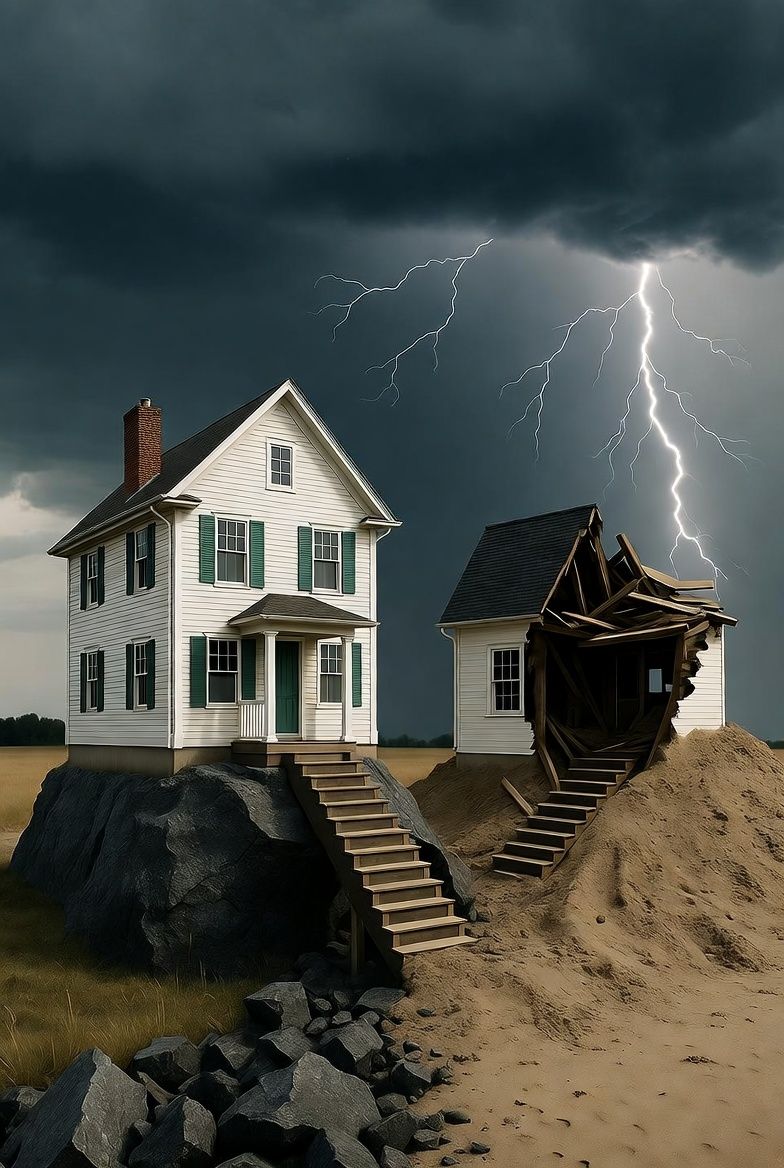
Matthew 7:24-27
Listen online HERE to the full podcast episode.
Lord, in Your Words we find our solid ground. Help us to hear and act without delay. Our hearts transform when faith in us is found. Build us upon Christ, our Rock, Lord we pray.
When tempests rage and floods assault our frame, may we not falter on the shifting sand, but cling to You, repenting in Your name. Through grace endure, upheld by Your command.
Lord, grant us might to stand the gale. Through each of our trials, anchored in Christ, we shall not fail. Both redeemed and revived.
In the culminating moments of Jesus’ Sermon on the Mount, recorded in Matthew 7:24-27, Christ delivers a profound parable that contrasts two approaches to life: obedience to His teachings versus mere hearing without action. This vivid illustration of two builders—one wise, one foolish—serves as a divine warning and invitation, urging listeners to examine their spiritual foundations amid life’s inevitable storms.
Jesus begins by declaring that anyone who hears His words and puts them into practice is like a wise man who builds his house upon solid rock. “These sayings of Mine,” Jesus emphasizes, refer to the entire Sermon, encompassing commands to love enemies, seek God’s kingdom first, and live righteously. True faith, as the sermon expounds, demands more than intellectual assent; it requires transformation through obedience. The message underscores that genuine regeneration comes from a life submitted to Christ as Lord. Obedience isn’t optional—it’s the path to forging resilience in daily trials like sickness or temptation. Dismissing Jesus’ words as mere ethics ignores His divine authority; only God incarnate could demand such absolute allegiance.
The parable intensifies with the storm’s arrival: rain descends, floods rise, and winds batter the houses. For the wise builder, the structure endures, symbolizing Christ’s unshakeable foundation. Biblical imagery abounds here, such as Psalm 18:2 where God is the Rock of refuge, and 1 Corinthians 10:4 which identifies Christ as the spiritual Rock. This rock isn’t Peter or rituals but faith in Jesus, validated by His resurrection. The tempest represents not just earthly afflictions—persecution, doubt, or loss—but the ultimate eschatological judgment. Anchored in Christ’s atonement, believers find assurance as they turn trials into testimonies of divine strength. No philosophy or religion offers such security; only the gospel provides the bedrock against which hell cannot prevail.
In stark contrast, those who hear Jesus’ words but fail to act are likened to a foolish man building his house upon sand. This folly often stems from delusion, such as assuming grace excuses disobedience, or living unchanged despite Scriptural knowledge. The sermon warns against superficial faith—filling pews or relying on tradition without producing righteousness, as Ephesians 2:8-10 teaches that justification by faith yields good works. Jesus’ call to repentance (Luke 13:3) challenges modern relativism, demanding exclusive obedience to His divinity.
The climax reveals the fool’s downfall: the same storm strikes, but his house collapses utterly, its “great fall” evoking apocalyptic judgment in Daniel or Revelation. Good works put faith on display, while unfruitful lives face eternal separation (Matthew 25:46). The Bible or church attendance becomes a snare if total surrender to Christ is ignored. Sinners are urged to repent and rebuild on Christ, who alone endured the storm on the cross for our redemption.
Ultimately, the parable presents two destinies: triumph through obedience or ruin through neglect. Christ beckons from the broad way of ease to the narrow path of action, where His words forge eternal lives. Hearers are implored not to harden their hearts but to cling to the Rock, weathering storms in grace-fueled faith. This timeless message calls for vigilant building, with eternal destiny hanging in the balance.

 The New Anabaptist Church